 |
| (C) 2017 Dale DiMauro |
The transition from winter to spring seems sudden, this year, in Vermont. Three Sundays ago I was cross country skiing, while today I mowed my lawn and put my kayak rack on the roof of my car. This week alone I saw a white skunk in daylight, a garter snake, dandelions, cats bathing in the sun and rolling in the dirt. A neighbor's dog even got free from its masters hold and took off for an inspired jaunt.
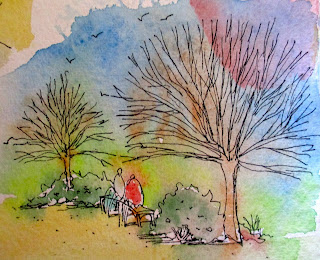
This is a simple watercolor sketch I did several years ago. It was inspired by the colors of spring. For me, there is something appealing about pen and ink combined with watercolor. The pen and ink conveys structure while the watercolor provides atmospheric affects.
On occasion, I pull out one of my fountain pens, which have beautifully flowing ink and start drawing. These fountain pens have water resistant ink, which do not smear when wet, enabling watercolor washes to flow freely with no concerns. My favorite fountain pens are made by Waterman, Pelican and Cross.
However, I find many types of watercolor paper are too textured to draw on, at least with a pen. Hot-pressed watercolor paper is one alternative choice, which suits me just fine.
 |
| (C) 2017 Dale DiMauro |
This is a little landscape sketch I did this afternoon between appointments. I was pleased with this as it is not on particularly good paper and my time was limited. When you use inferior paper I have found, you do not know what your going to end up with. However, I do like to experiment.
This image was done on a paper from an old packet of watercolor postcards that have been kicking around in my studio for a long time. Normally, this is about the size I test a color combination on before applying it to a painting. This small sheet is only 4" x 6".
What I like about this sketch is that it was done quickly with minimal fussing around. As one can notice, the grain of the paper runs vertically which creates interesting affects. After I lay down a wash I simply drop in pigment and brush it around a bit. I had fun working on this piece.
There is this new color that I am excited about, cobalt violet which can be seen watered down in the distant sky. Straight out of the tube it is an intense pale purple color but mixed with other pigments such as payne's gray, I find exciting, rich mixtures.
 |
| (C) 2017 Dale DiMauro |
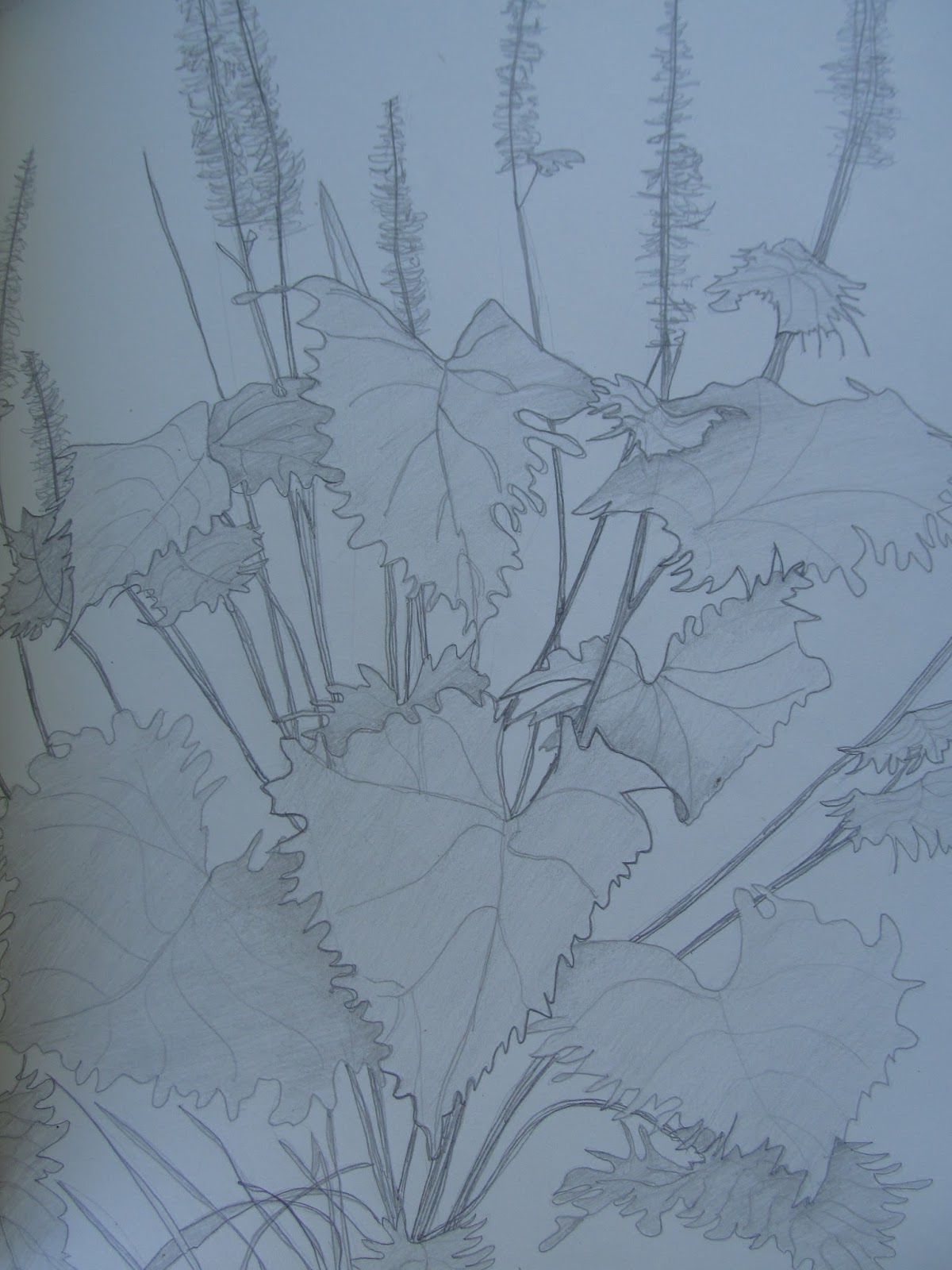
Towards the end of winter I was sorting through stuff in my closet when I came upon an old sketchbook with this drawing amongst others. It is of a plant from the genus Ligularia. I know at the time I was mesmerized by the architecture and grace of certain plants. Also, I had been studying plant communities, which are groups of plants that grow in similar conditions in natural environments. Plants from these communities tend to be healthier as they often share symbiotic relationships.
This is a favorite garden plant of mine. When it flowers in June, the yellow-orange blossoms are striking against the lush green leaves. In addition to the form, I appreciate the veins of the leaves, as well as the serrated triangular shapes. I have to admit, I like the soft rendering of the plant in this drawing.
With the glorious day we just had here in Vermont, one could not help but think of spring. My wife and I just came back from a short trip to Saratoga Springs, New York where the river valleys seemed to become greener by the minute.
 |
| (C) 2017 Dale DiMauro |
These days watercolor blocks are popular. They come in a range of sizes from 7" x 10" and smaller to 18" x 24". Watercolor blocks are quite handy as they are portable and the paper does not require stretching. They are useful when working on a study or painting outside. Watercolor blocks are often ten to twenty sheets of paper glued together requiring an artist to separate each layer with a palette knife. There is a spot in the middle back where there is an absence of glue, which enables you to slide a palette knife through.
They come with a cover sheet that protects the paper from the elements and general wear and tear. The inside cover is free space to record notes, doodle, test out color combinations and refine your composition. My art mentor Gerard Doucette, will often demonstrate a technique or idea in this space. I do little landscape studies and anatomy drawings in this area.
For me this has become a fun area to work and experiment. These studies I do spur me on to finish a painting after I have had time constraints or been interrupted for a prolonged period.
 |
| (C) 2017 Dale DiMauro |
Where I live in New England, there are many second hand shops. If you search out these places, there are treasures to be found. Within the layout of these stores there are displays for many vendors who sell all kinds of Americana from old wooden boxes to hand-made furniture.
Recently, I have taken a liking to these old cigar boxes which are great for storing artist pencils, paint tubes and supplies. I purchased these at a shop in Greenfield, MA, which always seems to have quite a selection to choose from. They are handy to transport art supplies, whether across the house or on a trip. I have found wooden boxes that close completely and others that have an open top, which are great to leave on my table.
One can certainly go to the local box store and purchase a plastic tupperware-type container, but for the same price or less I take some pride in reusing these storage bins, which have some regional history.
 |
| (C) 2017 Dale DiMauro |
There are some amazing marine painters producing inspiring work at their easels. Amongst others, I admire the work of Carl Evers and Jim Griffiths. Carl Evers was a master at portraying water and the many moods of the sea while Jim Griffiths captures historically accurate vessels from a different era with a fresh perspective.
Both artists have been affiliated with the American Society of Marine Artists(A.S.M.A.) which paint historically accurate pictures of ships during their heyday based on considered research. There seem to be a limited number of these painters who work in watercolor. However, they are quite impressive.
In that vein, I was eager to attempt an ocean scene of my own, not expecting to achieve their prowess any time soon. From my own experience I do enjoy the atmospheric effects one experiences when in coastal Maine down by the docks or in a protected inlet. When you add the rich smells of the sea and the sounds of the coastal birds you can begin to imagine all kinds of history.
Watercolor is a natural medium to capture the atmospheric effects of fog descending upon a ship or the last light of day.
 |
| (C) 2017 Dale DiMauro |
Many years ago, I purchased this hand-made artists watercolor-bound book, made in India. It is basically a sketchbook full of watercolor sheets. I have not been sure how best to use it as it has paper like none other. It has rough paper with a deckle edge and consists of sheets of a lighter weight than I usually prefer. In the photograph above, you can see that the paper is indeed rough, yet also tough. It takes some effort to work pigment into the lower areas of the paper.
However, after studying other artists who paint portraits, it occurred to me, that this is the perfect book to work on head or figure studies. I am very comfortable drawing on these sheets even though experienced artists will tell you not to draw on watercolor paper because if you have to erase, it will remove the fibers. Seldom, do I even carry an eraser when I draw so that aspect does not limit me.
I find the paper holds pigment well and dries quickly. Since I am not wetting the entire sheet I have not experienced any sheets buckling which can be a frustration for artists. In addition, individual sheets can be removed if desired. Finally, even though the paper is rough, I find it easy to attain detail when desired.
This week I began to use this book in earnest. I am only on the second page of fifty, yet am excited to see where I go with this. For years I have been searching for a watercolor 'book' with quality paper which provides the beautiful qualities that watercolor can attain. What is important to me is that I can peck away at a picture when time is limited or move forward in other directions. Progress is a great thing.
 |
| (C) 2017 Dale DiMauro |
This is a drawing for a future painting. It is a contour drawing done on trace paper providing room for change prior to painting. It is important to figure out your composition as much as possible before you start your watercolor. Determining the size of watercolor paper that I need is an important consideration. It is better to have a sheet bigger than you need, from which you can eventually trim off any waste, than force your picture into a smaller sheet.
This is an image of my wife checking her phone as she waits for a subway train one morning in Brooklyn. Her wet hair is swooped up onto her head in a loose bun, and she has that slack-jawed expression of distraction and obliviousness to her immediate surroundings. The new normal in our contemporary society seems to be a lack of awareness of our environment and a hyper focus on the little screen.
The first wash will likely be a gray-blue to set back the stark white of the paper enabling the figure to pop forward. Or I may even paint a graded wash which would become less intense as it fades into the distance. Either way the background will be kept simple.
I apologize for the poor photograph but have not had much success taking pictures of clear tracing paper in the past. It seems to capture that milky gray color with the crinkly quality of the paper. I try to take all my photographs in natural light as this was done and a majority of the time they come out just fine.
 |
| (C) 2017 Dale DiMauro |
This is a watercolor study for a painting I keep coming back to in my mind. I worked on this one earlier this evening.
It was mid- February when my wife and I went to Manchester, Vermont for the day. We recently had snow and the sky was as clear and blue as it could be. Late in the day we walked through the town park where the ball fields and trails are. The shadows across the snow and in the valley of the mountains were sharp and clearly delineated. This was the setting for this scene.
Not long after that day I started a full sheet watercolor, which I have since misplaced. I will state that it is hard to misplace a large watercolor. We were about to have some work done in the house so I stored it somewhere but I just simply cannot find it. I know sooner or later it will appear but this frustrates me because I was starting to gain momentum on the picture.
In the meantime I wanted to carry it forward. Figuring out how I might paint the silhouette of the deciduous trees below the distant hill is important. Also, I want to capture the glow of the skin tone which borders on the edge of orange in the sun as well as the warmth of the posture. The proportions of the figure will become further refined as I carry it further.
I do like the peachy color down by my feet over the snow. As a matter of fact, I think it is stunning. It is a reason artists like me paint.
 |
| (C) 2017 Dale DiMauro |
Inside the cover sheet of these watercolor blocks that they sell these days is prime space to make notes, record ideas and make quick drawings. I have used many watercolor blocks from a company called Arches, which has been around for centuries.
This is a quick watercolor sketch I made between paintings as I was inspired to see a little Spring in my life. For a while I have been trying to utilize the atmospheric qualities of light, mist and snow in my paintings. Watercolor is such a good media to exploit these qualities.
I have utilized this space to take notes on framing, sketch out compositional studies, doodle and document color combinations which I intend on using in the future.
 |
| (C) 2017 Dale DiMauro |
In the community, Brattleboro, Vermont where I live, there has been a major bridge project going on for years. Millions have been spent to replace this Interstate-91 bridge over the Connecticut River. Before they were about to open the north-bound passage which I have been told is in use, the town provided bus tours for those interested, on a wind blown weekend day. This photograph was taken from this new bridge which may be as high as one hundred feet above the water which provides dramatic views of the river valley.
If I use photographs as a reference or for inspiration I often experiment with ways to crop the image to strengthen the composition and simplify the overall layout. As you can see I use scrap paper or notepads or anything else I can find to crop the orientation and features which I find compelling. After having walked the expansive bridge which I was told was intended to be maintenance-free, I was taken by the local color of the distant hills and reddish color of deciduous undergrowth in and along the river.
I am certain this may be an odd post for some readers but I find cropping an image or making thumbnail-sized sketches invaluable in developing ideas which may ultimately lead to a well composed painting.
 |
| (C) 2017 Dale DiMauro |
This is a portrait I started a while ago and nearly finished. However, I knew there were some details that I needed to get right. These details included the all important facial features which if successful convey the characteristics of the subject of the portrait. Originally, I was attracted to the way the sun and shadows cross my wife's face.
Over the course of this winter I have done quite a few facial studies in pencil which has enabled me to see aspects of the face in a way I would not have depicted as well six months ago. I have added skin tone washes along the corners of the lips where we have natural creases when we smile or frown and made fine corrections to the perspective of the mouth which seem to make a big difference. The dark shadow in the corner of the mouth gave depth to the mouth and defined the edge of where the lips are. The shadow on the tip of the nose enhanced the sun on the other areas of the nose.
More time than anywhere else, has been spent on getting the pattern of how the hair rests to be correct. It may be hard to notice, but I have added naples yellow, an opaque pigment, on the dark background, where stray hairs caught the natural light .
There are just a few details left before I would consider it a finished painting. Some of the details include finalizing the eye lid, eyebrow and glasses.
 |
| (C) 2017 Dale DiMauro |
When I took this photograph earlier in the day I said to myself, I have to blog about this. For various reasons I have been painting portraits and landscapes on these narrow but vertical sheets. The most recent skinny watercolor I have worked on is the one on the far right. Plumbers were making a racquet in our house last week so I escaped to the upstairs and it was simply easier to work on a slim sheet. I originally worked on a skinny sheet because it was a remnant from a larger watercolor when framing. As I mentioned in a previous post, this vertical orientation is great for painting figure studies before I commit to the final painting.
The subject matter for the painting on the left was inspired from last summer's trip to Maine while the middle picture is more or less made up because I wanted to convey through an individual's posture a strong presence which I think is strengthened as the viewer is looking up towards him and then on to the sky. In the last image I was trying to achieve darks in areas of the water with less applications of paint in addition to creating dry brush affects in the sky with some hard edges.
Each one of the watercolor sheets above is manufactured by Saunders, an english paper producer. However, each one is of a different thickness with the heaviest on the left(300lb) while the middle picture is on 200lb and the far right is a 140lb paper. Each of the papers is of a cold pressed variety which means there is some texture, not smooth but enough tooth to create painterly effects depending upon how you paint.
 |
| (C) 2017 Dale DiMauro |
This is another one of those watercolor remnants that I will simply not let go to waste. In addition to Arches watercolor paper, Saunders which this is painted on, is probably my favorite. The water marks, drips, runs and overall landscape effects that can be achieved I find inspiring.
This is basically a doodle done in a little over twenty minutes as I misplaced the watercolor I had been working on the last few days which is nearly three feet long. I know it will turn up but this greatly altered my painting time. At this time of year, if I am not working on a watercolor for a period of time, I prefer to slide it into one one of these flat file drawers so it can be kept out of the direct sun. I have a studio window which faces south and I really notice the lengthening of the day in addition to the recent time change.
I do find these skinny watercolor remnants great for composing figure studies. They are fun to do and I believe I am improving along the way. As far as I am concerned, this could have been done at the foot of the hill where we live along the Retreat Meadows anytime during the outdoor season.
 |
| (C) 2017 Dale DiMauro |
Back in January I purchased this new palette set for painting outside. I have been eager to try it out ever since. Instead of the half-pan sets which are common, I prefer the full-pan sets. It is hard to slide your brush into those small pigment areas. Along the way the artist is also picking up pigment from the neighboring pans. In addition, I have learned the better sets use honey as a way to keep the pigment cakes from cracking or drying out.
Last fall I read a book by Mario Andres Robinson, an established watercolor painter, called Lessons in Realistic Watercolor. I recall he mentioned how most watercolor sets found at local arts stores or even at your local Micheals are student grade. These student grade sets offer weak color pigments, or at least from my experience. Mr. Robinson mentions the importance of seeking out professional grade watercolor pigments which provide much higher quality colors. The good manufacturers of these sets tend to have been around for years such as this set I purchased by Sennelier.
With the recent mild weather here in Vermont, it seemed that spring might be around the corner. However, the weather has turned much colder prior to this weekend and now we are forecasted to receive a major snowstorm. My excitement to try out this new set in our local river valley will have to wait a little longer.
 |
| (C) 2017 Dale DiMauro |
This is a local scene, relatively speaking. When my wife was off from work recently, we took a day trip to Manchester, Vermont on a chilly but beautiful day with great light and shadows projected on the land. Prior to this trip we had been told Manchester had yet to have a plowable snowstorm all season, but things had changed.
I am excited about the progress of this watercolor, which I started earlier this week; however, there is much work to be done. The sky was done with a large foam house painting brush. I like how the fence rails lead the viewer into the picture. The red hat creates an attractive focal point in the middle of the picture.
This is painted on a full sheet of watercolor paper, 22" x 30", which when framed, on a wall, makes an impact. I have wanted to paint a large landscape for some time. The vertical orientation I believe adds depth to the landscape.
 |
| (C) 2017 Dale DiMauro |
Last weekend I saw this documentary, I, Claude Monet at our local movie venue called the Latchis theater. Claude Monet(1840-1926) is considered by many to be the founder of French Impressionistic painting.
This documentary on Monet was well done, however I found it a bit dreary, which ultimately was the strength of the film. I say that because the film was narrated from Monet's point of view as there was no other dialogue or at least that I recall. He talks his way through difficult times in his life such as his ailing and ultimately dying first wife and his struggle to pay his bills as well as his approach to his painting process.
The primary reason I saw this film was because someone threw a new, weekly, newspaper, all wet onto our driveway, two days before it's showing. The grainy photograph of Monet in the art and film section peaked my interest as I have always been curious about his house and garden in Giverny, France. The grainy photograph was the source for this pencil drawing.
 |
| (D) 2017 Dale DiMauro |
The Maine coast is like no other place. The smell of the water, sound of the birds, vast open ocean and rocky shoreline are so strongly imprinted on my psyche. Already, I am longing for that annual summer vacation away from the summer humidity of Vermont.
Recently, I finished this watercolor which I had wrote about at an earlier stage. The foreground had been unresolved but now you can get a sense of how far the tide comes in. I like how the mossy, green rocks lead the viewer toward the water which takes you to the horizon.
There is a picture I had started on the back which I was not pleased with. It is of a local Vermont scene. It had been turned over sitting on my desk and I saw it as scrap sheet to try out. Since it is a thicker 300 lb Arches watercolor sheet, it has a rough texture compared to what I usually use. I do like some of the effects that can be utilized with this paper. This includes dry brush where you can create a great range of textural qualities for example, on the rocks and for achieving interesting edges in the sky with the clouds.
 |
| (C) 2017 Dale DiMauro |
This is a more completed version of my last post. As you can see I dropped in a figure looking towards the distant hills, as I thought the picture was lacking a focal point. The foreground has become darker and cooler as the individual is looking ahead into the distant light after exiting the woods. Making all of the various marks in the foreground I found very exciting to work on. For me they describe the season and time of day and give direction to the painting. This area has the most abstract shapes within it as I used a larger brush with greater pigment.
Getting the figure right took some effort as I drew on trace paper various figures and debated adding a dog to the left of the man. One of the critical decisions was how big to make the figure and thus, how much detail to include. I do like the man's posture and his clothing, plus how he is facing toward the other side of the field.
One of the qualities I was after in this picture was the way the late sun at this time year washes across the edge of the woods, a glow before the sun goes down.
 |
| (C) 2017 Dale DiMauro |
The woods and fields of the Windham Foundation are traversed by many in Brattleboro who are trying to get a walk in. I have walked across these fields many times, in all kinds of weather. Over time I have learned to appreciate the changing light with subtle and dramatic changes in the sky.
As I began to paint this watercolor, it seemed to have the qualities of an oil painting. There is a build-up of paint in the foreground while the tree line to the right has a glow as if from the light you see in oil paintings. In addition, I tried painting the sky differently, giving the clouds a layered and hard edged appearance.
The ground plane has been a struggle to get just right. I have learned that the landscape needs to be a distinct value darker than the sky to give it a solid grounding and separation from the sky.
At this point in the development of the painting I have come to realize the foreground needs something to give it a spark. I plan on adding an individual to the right foreground, looking towards the distant hill. I might even add a dog in front of the person to strengthen the focus of the picture.