Sunday, July 28, 2019

Stickney Brook II

(C) 2019 Dale DiMauro

As you may have figured out by now, Stickney Brook is one of my favorite local plein air spots. The dappled light, burst of foliage, cool breezes and water in its various forms is enticing. In numerous points along the brook you have falls, pools, eddies and meandering, offering diverse vantage points to paint and dip in.

I sat on a flat ledge-like rock, seat height, with my feet dangling in the rushing water. The light was changing quickly so I worked fast from top to bottom. These days I have evolved to rotating the watercolor block in my hand to manipulate the areas which are wet until I move on to another area. The spatial qualities of the brook I feel good about even if the foreground could use some finishing touches.

This Summer I have been using Holbein watercolors almost exclusively for painting outside. One of the great things about painting outdoors is the simplicity one attains whether conscious or not. For this painting I only used two brushes.


Wednesday, July 24, 2019

New table for plein air painting

(C) 2019 Dale DiMauro

Yesterday, I happened upon a table suitable for plein air painting. Or at least for my needs. I was downtown in our local sporting goods store where they stock portable folding tables and chairs intended for the outdoors. This one is aluminum, thus very light and quite handsome, I must add. Including sales tax it cost under forty dollars. 

It beats perusing a mail order catalog or online where you are not quite sure what you are purchasing until it arrives at your door. The employee I met was knowledgeable about its assembly and the various settings to utilize. So I am quite pleased with this purchase.

The last two paint outings have been frustrating with regards to holding my brushes, palette, water container, etc. Most of the time outside I find an easel is not necessary. With this table I am convinced it is convenient to paint sitting down or standing. It is a good feeling to be able to put things down and change your position from time to time. Also, the setup is simple and quick, which is key when working outside. The wind or rain can come your direction in no time at all.

Sunday, July 21, 2019

Stickney Brook Falls

(C) 2019 Dale DiMauro

During the recent heat and humidity I have painted several plein air watercolors at this local watering hole. While painting, it feels great to hear the sound of rushing water with a shady canopy overhead. It is also refreshing to take a dip or walk through the water where it is low in spots.

I don't know if I would call this a finished painting even though it probably will not require much more work. When the first few washes were put down I was full of excitement at the direction it was heading. The colors remind me of this particular place at the time I was there.

I have come to the realization that I am mixing colors that match what I see out in nature. I can't say that I could do that in the past, at least consistently. The other thing I have been working on is contour drawing. If I really concentrate when drawing and painting outside I seem to be able to layout the image I am conveying quickly. This is important when plein air painting as the light and color is constantly changing. 

In conclusion, it is important to focus on one area of the landscape, not all the stuff before you. It takes time to develop an eye for what you want to develop on your watercolor paper.


Thursday, July 18, 2019

Ashuelot River

(C) 2019 Photograph Dale DiMauro

Vermont is a beautiful place to live. Sometimes I lose track of this. Particularly, when the demands on my time are great. As a result, it is important to get outside and embrace the natural world. Fortunately, I can take a hike and access this wonder quite readily. It can be even more rewarding to paddle through an abundance of greenery and see wildlife first hand.

After a busy Spring, work wise, I am back to watercolor painting both in the studio and out in the landscape. I took this photograph last month, from the bow of my kayak, while paddling on the Ashuelot River in Keene, NH.

I have noticed the transformation of the foliage around us from the yellows of Spring to the heavier blue/greens of Summer. In retrospect, it is good to reflect on the natural world which we live within. Particularly, as the seasons change so rapidly, at least here in Vermont.

It was not until this afternoon when I realized I had failed to write and publish a post on Wednesday. So this is it.


Sunday, July 14, 2019

Sargent: The Watercolours


When my wife and I were last at the Clark Art Museum I purchased this book. It is titled Sargent: The Watercolours, by Richard Ormond and Elaine Kilmurray. I have not read this in it's entirety but it already makes me look at John Singer Sargent's watercolors in a different light. 

The low angle which Sargent preferred to view or portray his subject is clear as day. In the photography of Sargent's watercolors, or at least those selected for this book, one can feel the brushstrokes made across the paper with either dry or wet edges. Most of all, perhaps, is Sargent's direct approach to painting with minimal fussing around. As a result of his mastery of drawing, or sureness of line, his economy of colors radiate from the paper. This moved me in ways no other watercolor paintings have, period.

John Singer Sargent not unlike his sister Emily, never married and shared a mutual interest in the arts. I have read in previous books on Sargent, Emily's understated interest in watercolor. However, on page 142 I was thrown when the authors state that a 'recent discovery of more than five hundred of her watercolours in a family trunk has confirmed her talent and revealed her as a serious and dedicated painter.'

While writing this piece I find it ironic because it is hard to find watercolors on exhibit when I attend most major art museums. I have asked countless museum employees if there are any watercolors on exhibit. They either do not know or seldom exhibit works on paper. Now I understand watercolor paintings are sensitive to light and the paper can and will deteriorate. 

However, we live in a time when the technology for art preservation and the evolution of materials are greater than perhaps, any point in history. Watercolor has become a unique American medium due to it's portability and low cost. We owe Winslow Homer some credit for this as most of his art materials were not available at the time in America. As a result, plein air painting has grown in popularity ever since.


Wednesday, July 10, 2019

Ida Ten Eyck O'Keefe


From my visit last weekend at the Clark Art Museum this painting has became etched in my memory. There is something simple yet extraordinary about this composition. I believe it has a lot to do with the colors or at least the concentration of color against a subdued background.

This oil painting titled, Still Life(Still Life with Fruit), was created by the late Ida Ten Eyck O'Keefe(1889-1961) in 1926. She was a younger sister to Georgia O'Keefe. Georgia, being the older sister, claimed she was the artist in the family and wanted to keep it that way. What is it about sibling rivalry and what does it tell us?

I found the exhibition on Ida Ten Eyck O'Keefe paintings fascinating. She was no amateur painter and had a clear aesthetic. For me her still life paintings stood out as they had vibrant color, not to minimize her landscape paintings. 

The current exhibition at The Clark is titled: Ida O'Keefe: Escaping Georgia's Shadow: July 4 - October 6, 2019.


Sunday, July 7, 2019

John Constable


Yesterday, my wife and I got out of the heat and headed to Williamstown, MA. We made our annual pilgrimage to the Clark Art Museum, located in the Berkshires. We have not found many world class art museums set in a rural environment such as this. 

On the drive over I noticed how important it was to have large, mature trees in our life. The environmental benefits provided by the shade and lush greenery made it a more enjoyable day. The cultural landscape of our every day experiences at home consist of treeless parking lots and the proliferation of scrawny fruit trees. In general, there is a mindset that trees are too much trouble with all the raking and pruning etc. However, to experience a tree that is allowed to grow in a heathy setting for decades and even centuries, truly is beneficial to our species.

Enough with my rant. My wife and I made sure our beloved paintings were still hanging on the walls of the Clark Art Museum. There is a masterful Thomas Gainsborough double portrait which we admire in addition to many John Singer Sargent paintings. There are too many other great painters from the past with their works on display to include here.

However, this classic John Constable(1776-1837) painting titled The Wheat Field, I associate with the very first time I visited the museum which was decades ago and certainly prior to to the museum's recent expansion. Constable, an Englishman, painted this oil on canvas in 1816. 

The write-up by the painting at the Clark Art Museum succinctly states that traditional farming practices were disappearing as a revolution in agricultural techniques swept across the British countryside. This nostalgia Constable felt was a result of a rapidly changing way of life. There are parallels to the times we live in, certainly full of technological advances whether for the advancement or regression of society. Regardless, I love the color of the wheat field and regrettably, acknowledge how greater connected to the natural world our ancestors were.


Thursday, July 4, 2019

Saving your Watercolor with Corrections

(C) 2019 Dale DiMauro


This is the subject matter from a few posts back. I have been trying to capture this time of year with all the verdant growth. Then on top of that, this proliferation of green is cast onto the water as a shadow.

On the top left corner of the watercolor I inadvertently got some green pigment on the page. This is a staining color and thus hard to remove. I am not sure which color, perhaps pthalocyanine green. However, I did lift most of the pigment and will try again to make it a non-factor.

Many people claim that watercolor is such a difficult media to handle. Regardless, of differing perspectives, there are readily available remedies to correct problems that you may find your self in. In this case, I dampened the area of the paper in question with water and lifted it with a paper towel and small scrubbing brush.

Watercolor is all about marking the paper with which ever technique you choose. This may be include pigments, pencil, masking, gouache, etc. You as an artist just have to find an additional technique to draw your eye away from a particular flaw.

Sunday, June 30, 2019

Asparagus Festival

(C) 2019 Dale DiMauro


A few weeks back I went to an Asparagus Festival in Hadley, MA. It is situated within the Pioneer Valley, one of my favorite rural landscapes to visit. The old historic buildings in combination with the mature, majestic trees which frame the green are much revered. It is even more appreciated on a hot, sunny day such as my wife and I experienced.

This watercolor is a result of that experience. Painting layers of foliage is usually not an easy task for watercolorists. However, I like the sunny and shady areas portrayed in this picture. It is easy to overwork the painting but I feel like I put the brush down at the right time. It is better to keep it simple but harder to follow this principle.

As a final note I want to mention there is a lot of hansa yellow used in creating this watercolor. I find it a useful pigment for mixing yellowy-green foliage and vibrant lawn areas which don't look so manicured.

Wednesday, June 26, 2019

June in Vermont

(C) 2019 Photograph Dale DiMauro

This spring in southern Vermont has often been overcast and wet. These cloudy and cooler conditions have amplified the richness of greens emerging in the landscape. On a recent paddle these yellowish-greens above the water looked stunning. They added a vibrancy to the landscape.

This color or experience inspired me to purchase a tube of green paint called Azo Green which I had not heard of before. To me the color on the tube was a microcosm of the green I saw out in the landscape. I figure it was time to stretch the palette a little with this color in mind. It is amazing how a color just like a smell can carry associations over time.

I have had a lot of work this spring forcing my painting to lapse at times. However, in my travels I see colors more clear than I have ever seen before. Hopefully, this will lead to greater watercolors fueled by a stronger vision.


Sunday, June 23, 2019

Dennis Bunker


This painting by Dennis Bunker(1861-1890) was on exhibit in the American Wing last week when I visited the Museum of Fine Arts in Boston. While Bunker did paint watercolors at least early on, I believe this painting is in oil. It is titled The Pool, Medfield 1889.

While Bunker was born in New York City, he spent much time in the Boston area and New Hampshire. He was a major American painter of the late 1800's and was friends with the prominent artists of his era. These artists included John Singer Sargent, Augustus St. Gaudens and William Merritt Chase amongst others. 

He was characterized as an American Impressionist with loose brushwork and vivid colors. Unfortunately, he died from meningitis at the age of 29. 

When I first saw this hanging in the museum I could imagine it as a watercolor. I can feel the moisture on the paper and in the landscape. This painting has a lot of the blues and greens we experience during the growing season. The flowing water draws you into the painting just as a path across the landscape leads your eye. One of the things I like most about this composition is the sliver of sky across the top with two thirds of the canvas consisting of the landscape.

Wednesday, June 19, 2019

Museum Epiphany III


On Tuesday I went on a bus trip with a group from the Saxton's River Art Guild down to the Museum of Fine Arts in Boston. Actually, it was more of a van trip as I believe we totaled fourteen passengers.

Now, I don't go to this museum that often. However, the last two times I was eager to see if they still had this very contemporary painting hanging saloon style amongst many historic gems in the American wing.

The above painting hanging on the left center of the photograph is titled Museum Epiphany III, 2012. It was painted oil on canvas by Warren Prosperi, an American artist born in 1949. The write-up by the painting mentions that he collaborated with Lucia Prosperi(a presumed relative) who was born in 1951.

When you are in the gallery viewing this painting, that very white sculpture in the painting resides right behind you. It makes you feel as if you could have been in the painting. It makes it very contemporary.

Other than the young girl, all the models in the painting are largely preoccupied with subjects on the perimeter of the canvas. These qualities where an arts patron is seriously studying a piece away from what else may be going on in a gallery we experience every time we visit a major art museum. 

Sunday, June 16, 2019

Living Memorial Park

(C) 2019 Dale DiMauro

For those who paint, it's plein air season here in Vermont. For now, the snow and ice are long gone. The variety of green foliage in the plant kingdom is bewildering. Lately, the landscape has become quite lush with growth.

There was a group from the Saxton's River Art Guild meeting for a plein air event. Since I had to leave early to go to work I painted on my own. This is a modified view from the stone bleachers which look over one of the softball fields. As I was leaving a woman pulled up in her car and took out her gear and headed toward a lower vantage point from the same stone bleachers.

You might think I used one tube of green for this watercolor. Actually, I do not have any green at all on this particular palette. I used many blues, yellows and burnt sienna for this picture. I like the fresh quality to this painting. Oh and I had an hour and one half to paint what I could.

Wednesday, June 12, 2019

Charles Reid


The world of watercolor lost a celebrated heavyweight in Charles Reid(1937-2019). He painted in oils and watercolor for nearly sixty years. Over his lengthy career he worked as a fine artist, illustrator and teacher. In addition, he authored eleven instructional books on painting. The above book, Painting FLOWERS in Watercolor with Charles Reid, is one of my favorite books on watercolor. I purchased it in a local bookstore used, for ten dollars. The quality of the printing and page material is superior to any newer versions I have seen. The minute I saw it I knew I was not to leave without it.

Charles won many awards for his paintings such as the gold medal from the Portrait Society of America and several Altman prizes from the National Academy of Design. It was his mastery of the human figure which drew my eye towards his work. His drawing was precise with an economy of line. To the public's eye his paintings perhaps, look unfinished as the background is often left white, the color of the paper. However, his ability to capture the proportions, posture and attitude with the freedom of color and brushwork before a model I find amazing.

Recently, I have followed his facebook feed which on most days posts his daily paintings and travels while teaching workshops all over the world. These seem to be a sort of open sketchbook. His painting style is so unique that I can't think of another painter like him.


Sunday, June 9, 2019

Vermont Watercolor Society

(C) 2019 Photograph Dale DiMauro

The Vermont Watercolor Society had their annual meeting today at the Landgrove Inn in Landgrove, Vermont, not far from Stratton Ski area. It was a picture-postcard day as can be seen from the above photograph, with it's bucolic environment.

It was difficult to be limited to the indoors on such a beautiful day. However, we learned of the society's new website which is up and running at: www.vtwatercolor.org.

After lunch we were treated to a solid demonstration by Andy Evansen, a landscape painter. He talked and answered questions while painting which was very informative. His goal is to complete a painting in a couple of hours.

Wednesday, June 5, 2019

Great Blue Heron

(C) 2019 Dale DiMauro

Recently, I have not had time to paint watercolors. However, I did get my first paddle in today. The three other paddlers I was with were able to get quite close to this Great blue heron, even though he was well camouflaged amongst the brush. In addition, we saw quite a few red-wing black birds.

Tully Lake in Royalston, MA is a lovely body of water to paddle. It even has an impressive waterfall. It is best to go during the week as the weekend attracts too much boat activity.

On a down note, I was paddling in the middle of the lake when a sizable C-130 military cargo plane roared over me at a low level. It was so low and noisy I thought it might crash or hit me. It was literally one hundred feet or so above the surface of the lake.

Sunday, June 2, 2019

Playing with Color

(C) 2019 Dale DiMauro

It is rewarding to learn of new pigments or color combinations and experiment with them. This color swatch I come back to repeatedly as it freezes me in my tracks. This ten minute painting can be an abstract or realistic picture dependent on how much effort you want to put into developing it.

In the sky we have cerulean blue. The purplish color comes from the combination of alizarin crimson and ultramarine blue. Below this we have pale yellow cadmium bleeding into this wash.

There is a freshness to these colors and washes I do not find on a daily basis. In addition, the white of the paper, in contrast, adds a speckling and hard edge.

Wednesday, May 29, 2019

Spring Light

(C) 2019 Dale DiMauro

Warms against cools and vice versa in watercolor can make a picture sing. Particularly, when there are soft edges that bleed together. I have learned the hard way that there are times when it is best to leave a wash alone. This is one such example.

This is one of those little landscapes I create when I have limited time. Continuity is important in painting as in others aspects of life. 

There is an intuitive element about these that I find mesmerizing. To turn the paper on edge and draw the wash across the paper creates excitement and changes your perspective. In addition, the absence of color makes other areas with pigment stronger. Often less is more. 

Experimenting with color and pigments is quite addictive. If there is any time of year to broaden your horizons this is it. As Spring continues to unfurl new colors and forms everyday we see the world with a fresh eye.

Sunday, May 26, 2019

Abstract Landscapes

(C) 2019 Dale DiMauro

In the last few years, when painting a landscape, I have appreciated the early stages of the process. There is an abstract quality to watercolor; when if you seize the moment, you can exaggerate the atmosphere, color or drawing to your preferences. By this I mean you can take the painting in a totally different direction. For a study I find this to be desirable as the light on the landscape is always changing anyway. 

When painting outside, I find myself trying to capture or record what the eye sees before it changes. At the same time I believe the use of my palette is evolving with new color combinations as a result of what I am seeing.

This watercolor is inspired by a visit to the Audubon Society in Portland, Maine. During the summer, they have these lovely trails through the woods with shoreline vistas and, equally important, mowed paths cut through their meadows. If you pay attention while on a stroll, you will notice much bird activity.

Wednesday, May 22, 2019

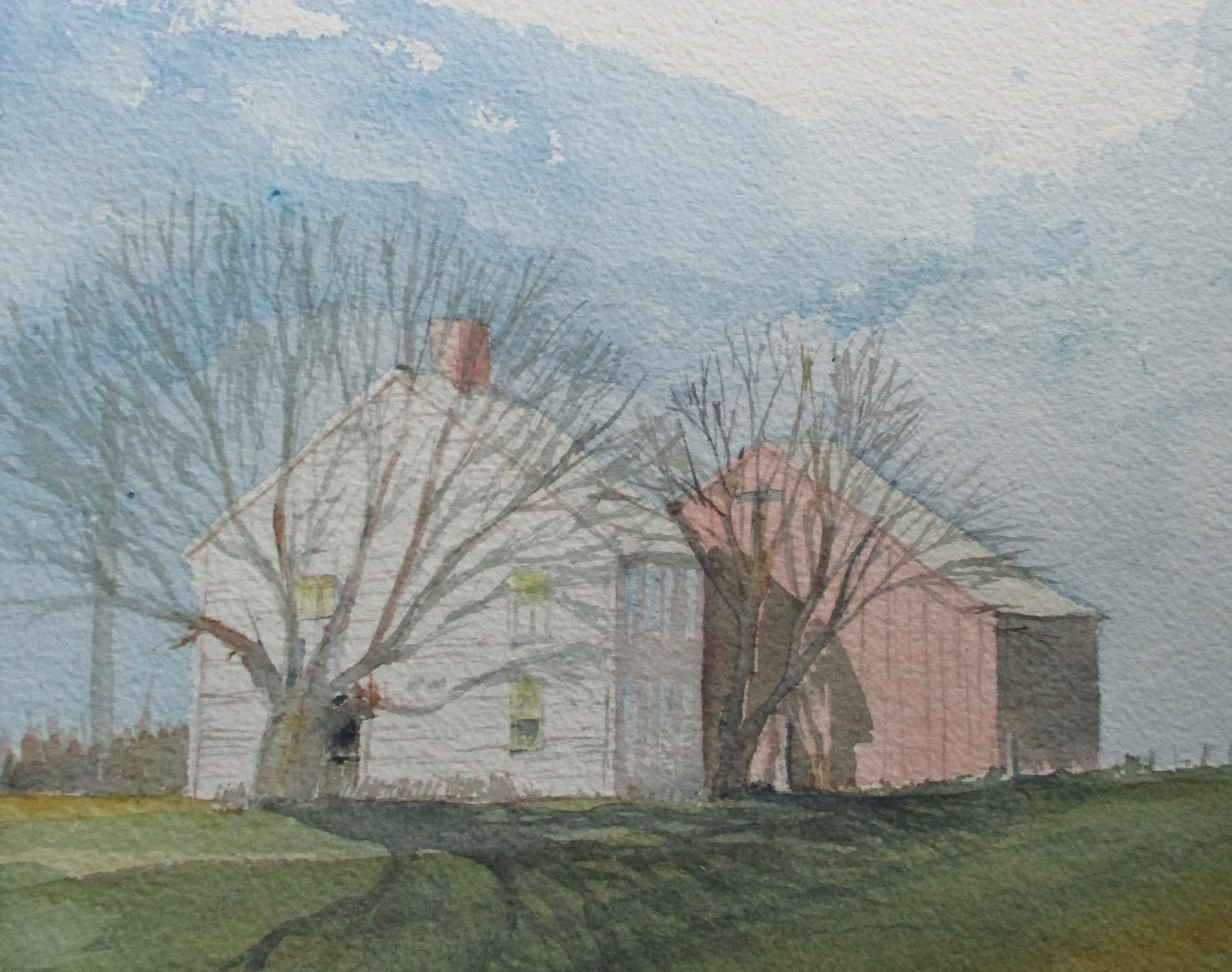
Farmscape

(C) 2019 Dale DiMauro

This painting was started last fall, at a watercolor workshop, led by Robert O'Brien in Vermont. Most of it was painted in that one sitting. It has an overall pleasing feel to it. Or at least that is my take on the subject.

This painting is done on the thicker 300lb Arches watercolor paper in contrast to the thinner 140lb paper, which I often use.

Part of the appeal for me is the expression of the sky. Usually the first wash I do, is in fact, the sky. I left it at the time, seemingly incomplete even though the dry brush affect intrigued me.