Sunday, August 8, 2021

Middlebury, VT

                                                                     2021(C) Photograph Dale DiMauro
 

Last week my wife and I went on a vacation in Vermont. We spent time in Middlebury, Montpelier and Woodstock, Vermont. In Montpelier, we toured the statehouse, on a Saturday and ran into the Governor and a neighbor pretty much all at the same time. We learned that the original carved figure on the statehouse dome was created in Brattleboro, by a worker from the Estey Organ Company.

Not far from Montpelier, we hiked in the Goshen State Forest(26,000+ acres) and I dipped into the largest of it's numerous lakes on a deserted beach with the sound of loon calls in the background. Also, in Montpelier we climbed the tower in Hubbard Park above and adjacent to the statehouse grounds.

In East Middlebury, we stayed at an inn which was used as the backdrop for the opening sequence of the Newhart Show, back in the 1980's. In the morning on the last day before heading out, we learned that parts of Windham County, in Vermont, were inundated with more rain and that Governor Scott had toured some of the damaged areas. 

When in Middlebury, my wife and I just sort of came upon these falls which were roaring right through the center of town. There is a major construction project in town too. The train will be going under the town center which now has newly established gardens and parks above the tracks.

On the drive home we visited the Texas Falls which are located in a deep gorge on the edge of the Green Mountain National Forest. 

There was little time for painting but plenty of inspiration to be had each and every day. In retrospect, Vermont has a lot to offer it's residents and visitors alike.


Thursday, August 5, 2021

Charles Reid


Charles Reid(1937-2019) is one of my favorite watercolor painters. He was known for his drawing skills and considered a master of watercolor. Reid was a successful teacher, workshop instructor and published numerous books. I own several of his books.

I admire his fluid, free flowing and direct approach to watercolor painting. In that vein, last month, I painted a copy of one of his watercolors, titled, Macy 2. My version is pictured above. I painted it in one sitting, which it seems like how he would have approached it.

Reid in watercolor did not build up too many layers of pigment so I tried this method, too. In addition, where possible, I tried to use the pigments he would use.

It is important for me to try other artist's methods as a break from my own routines.

Sunday, August 1, 2021

Watercolor Sketch

                                                                                       (C) 2021 Dale DiMauro
 

Sometimes the absence of color can really work to your advantage. When painting water in the distance it often is either, misty or faint in coloration. This area is best left with soft edges. Also, it can create a greater sense of distance.

In contrast, smooth, rich saturation of color in the foreground can bring a lot of excitement to your painting. I am continually experimenting between these two extremes in landscape painting. The other aspect in landscape painting which has begun to capture my imagination consciously or not is the sense of space in a picture. The simpler the composition the more powerful one can be drawn into the atmospheric characteristics of a landscape.

What I like about this watercolor is the smooth, rich coloration with just a few washes of pigment. The freshness of paint one can achieve in watercolor is unlike any other medium. 


Wednesday, July 28, 2021

Summer Landscape

                                                                             (C) 2021 Dale DiMauro
 

After working too much lately, it was great to get back to watercolor painting. We have had so much rain in July, they say, record numbers, that the landscape is greening up again.

I tried to capture some of those vivid colors in this watercolor. Blues and greens are vital to painting the landscape in Summer.

Continuity in watercolor painting, I find, is important, as approaches to painting are continually evolving. For example. I have been searching for that elusive dark green of foliage you often see when looking from a shady area out towards sunny areas. Of late, I have been combining burnt umber and ultramarine blue which provides a rich dark.

Sunday, July 25, 2021

Test Sheet II

                                                                          (C) 2021 Dale DiMauro
 

In previous posts I have profiled the value of using test sheets. An artist may use a piece of scrap paper or a piece of watercolor paper, left over, after being trimmed down to size, during the framing process.

First of all, it always worthwhile to experiment with different papers as the pigment will mark differently from paper to paper. Over time one learns how to manipulate the paper to their liking. This includes learning how the pigment dries on the paper and when you can go back into a painting to add more pigment or not.

When I am trying to come up with a color for my painting it is a good idea to see if it is actually the color I want before committing it to my painting. This is a great time to simply play with pigments on the paper without over thinking it too much.

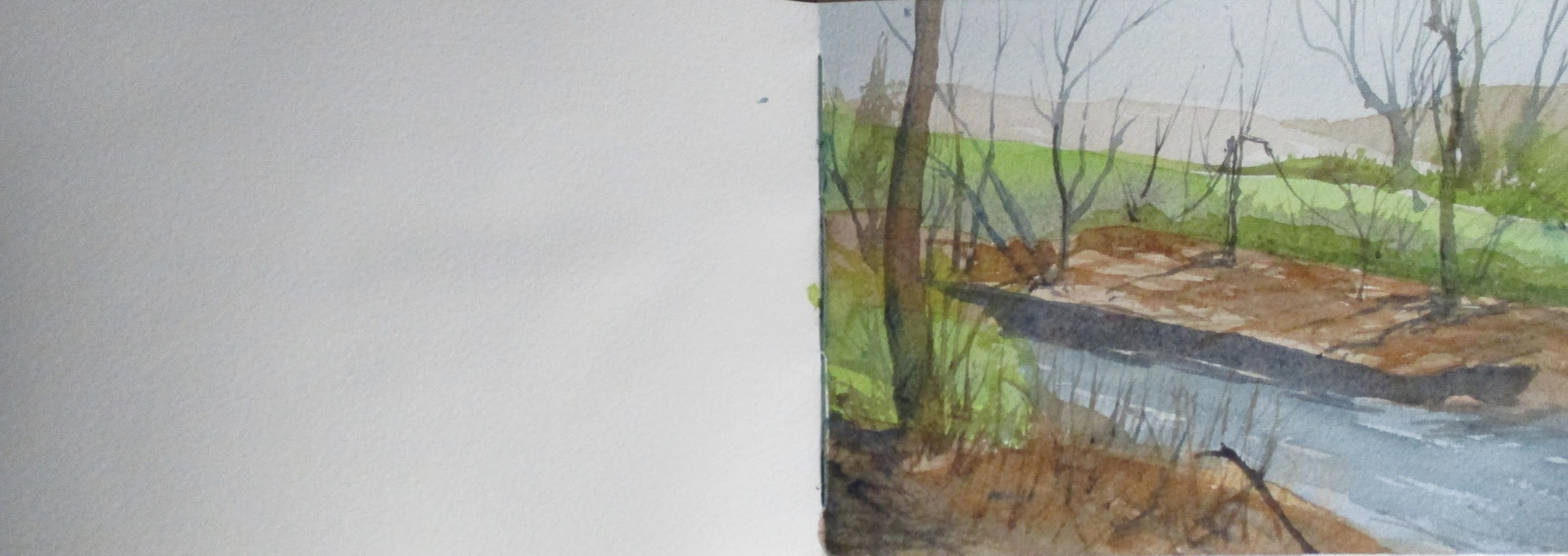
These two images are little landscape doodles which get the creative process going. In the top image I mixed colors(raw umber and burnt umber) which I don't usually mix together to create a brownish sky which brings out the color of the water. In the lower image I am forever combining blues and yellows to come up with combinations for vegetation which can distinguish the foreground from the background.

Wednesday, July 21, 2021

John Constable

                                                                               Painting by John Constable 

It has been a long time since I have left the state of Vermont. In many instances it is best to not leave Vermont because it is truly a beautiful state. It is not dominated by strip malls, overpopulation and polluted air which other urban areas strive to overcome.

However, yesterday was the first time I entered a neighboring state, Massachusetts, in over a year. My wife and I went to the Clark Art Museum, in Williamstown, MA. It was good to escape the thick, humid air and visit some favorite paintings of ours. We checked in our favorite paintings by the likes of John Singer Sargent, Thomas Gainsborough and Mary Cassatt, amongst others.

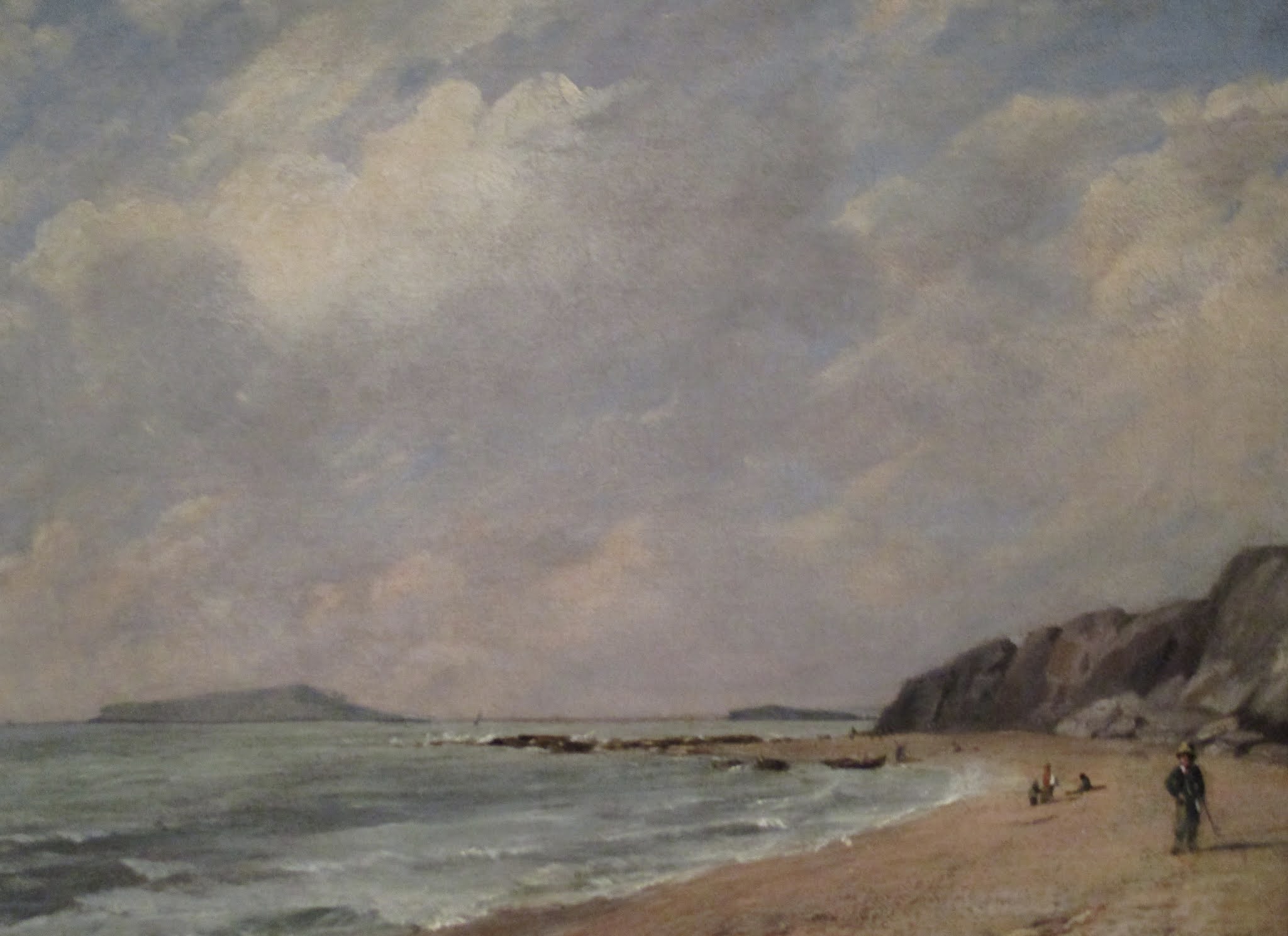
Over time, I have learned to appreciate the landscapes of english painter, John Constable(1776-1837). This small landscape, painted in 1816, oil on canvas, is titled, Osmington Bay. In addition, to his cloud studies, which he is well known for, I learned he painted landscapes in watercolor, too.

I like the low horizon with the big sky and sweeping beach. It seems to be such a timeless subject with an individual providing a sense of scale. 


Sunday, July 18, 2021

Summer Portrait

                                                                           (C) 2021 Dale DiMauro


It is always a good idea to paint family members and others in your life so you can do an improved one later on. More importantly, it is best to catch someone in their natural state. A posed portrait is rather stiff and uninspiring.

We as humans are continually aging or evolving and thus never quite look the same from day to day. Or at least that is my experience.

I pre-stained the paper before painting this portrait, but you can hardly tell. However, I think the coolish tone enhances the red on the page. 

Finally, I don't think you should over work a portrait because one always sees things about that person which can alter your perspective. As long as you place the location of the facial features correctly, you have a good start to your painting.

Thursday, July 15, 2021

After the Storm

                                                                                      (C) 2021 Dale DiMauro
 

Using or leaving the white of the paper can be an effective strategy in your watercolor painting process. Also, it is great to not cover every inch of your paper every time you paint with pigments. The white of the paper can give you distinct edges reminiscent of patterns on the surface of a body of water. In addition, you can retain greater depth in your picture with less layers of paint in various areas.

Often I combine permanent alizarin crimson with ultramarine blue lower in the horizon which provides some warmth to the lower sky. On the other hand vibrant greens I associate with the landscape after a spring rain.

I used the photograph editing tool on my computer to remove a smear of brown paint from the sky. I can't believe how effective this function is. This is the first time I ever used it on a larger area.

Monday, July 12, 2021

My Latest Watercolor.......

                                                                                 (C) 2021 Dale DiMauro
 

With such a run of sunny days this spring, it seemed important to try capturing some of the characteristics of the light and the many greens all around me here in Vermont. My exploration has resulted in three landscapes on one sheet.

In the last year I have fully embraced using mop watercolor brushes. One of my favorites can be seen on the right in the photograph. They lay down a meaty wash and retain a fine point for detail work. This means one less brush to carry outside when painting plein air.

I have been searching for this opaque foliage color/value, the saturated dark green-brown of the deep shade, used here for the scraggly vegetation in the foreground. This would take my paintings to a whole other level. The misplaced blob of paint in the upper left is a Van Dyke brown, which is closer to what I am searching for. However Van Dyke brown is considered a fugitive pigment and fades fast in sunlight and thus, not permanent.

Thursday, July 8, 2021

Imaginary Landscape

                                                                           (C) 2021 Dale DiMauro
 

Sometimes the best paintings develop when I am tired. When I am tired direct painting takes over. I become too impatient for contemplating which colors to use or fussing over which brush to use and simply paint.

Also, there is a freshness to this method of painting. Watercolors can become overworked but not with this approach.

If something catches my eye out in nature and I need to record the colors or image, this is the way I paint. This is basically a study. Regardless, there is much to be said for this way of painting. This is sort of a recording which can jog my memory at a future point in time. 

Sunday, July 4, 2021

The Brattleboro Common


                                                                           (C) 2021 Dale DiMauro


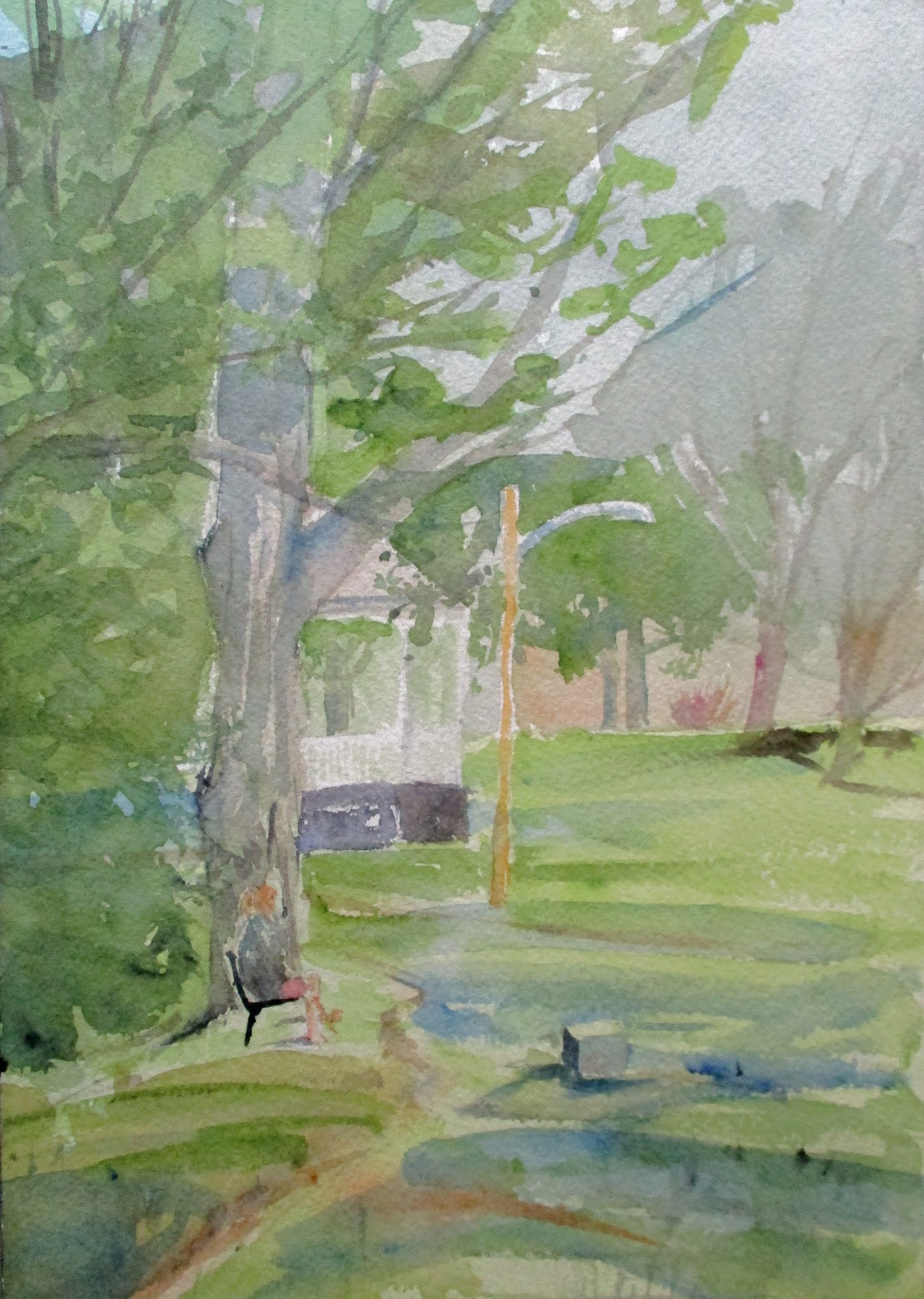
Plein air painting can be a wild ride of unpredictability. Late this afternoon I painted this watercolor from a picnic table on the Brattleboro Common. It was exciting to work on this picture when the paper and pigment were still wet and juicy. 

Of note, I took a very direct approach to painting this scene. I kept painting areas while other areas were still wet. Also, I did minimal drawing prior to painting. Thus, I worked out the composition as I painted.

However, as it dried it looks a bit flat while the photograph is not kind to the subject matter. It is a challenge and rare to completely finish a watercolor in one sitting.

What really drew me to this perspective were the two women sitting on the park bench. It is great to have a human presence in your paintings. However, they clearly do not dominate the scene. I like the sense of depth in the picture and the layers of foliage.

It goes to show every once in a while you come up with a dud. However, I learn the most from these experiences.

Wednesday, June 30, 2021

Watercolor Painting

                                                                                       (C) 2021 Dale DiMauro
 

In the summer when the days are long, there are many distractions to keep you from painting. Continuity is essential to continued progress. Observing, recording and painting the colors out in nature I find valuable. This process seeps into your developing palette.

When outside you must learn to simplify your composition. You can't cram every little detail into your paintings. With the changing light you develop a greater connection with the natural flow of life. Ultimately, I find this experience relaxing.

I hope my paintings in my watercolor-bound book express some of these qualities. It has sixty-four pages to paint on and I have painted on four pages thus far. There are portraits in addition to landscapes and color studies. However, the portability of this painting surface is most appealing, particularly as time is limited in the busy summer months. Also, it fits neatly in my bag without taking up much space.

Sunday, June 27, 2021

Color Studies

                                                                           (C) 2021 Dale DiMauro

Just as pencil sketches are great aids in finalizing your compositions, color studies can be helpful in figuring out which pigments you will use. Even quick little studies can jog your memory when you are back in the studio. If painted out in the field you may match colors you would not normally combine which can really broaden your horizons and palette.

In landscape painting I prefer to convey depth in my watercolors. I try to achieve this through color saturation in the foreground and by utilizing drawing skills. If you can convey sunlight on the land or conversely shadows cast from trees or buildings it adds much to your painting.

It is always fun to see how the paper reacts when the pigment is applied. These color studies were done on rough Fabriano watercolor paper. The warm orange color on the image to the right is burnt sienna. I try not to waste paper so there is an image on the back, too.

Wednesday, June 23, 2021

Plein Air & Unleashed Dogs

                                                                                      (C) 2021 Dale DiMauro
 

This morning I was painting outside by the Pleasant Valley Reservoir, in Brattleboro, Vermont. And it truly was a beautiful morning to be outside and painting. 

My watercolor was rapidly developing when I was accosted by two unleashed dogs. One was a black Labrador who showed me his teeth and circled around me for twenty minutes while the other was an older dog who was of no threat. After some time had passed, a woman walked by apologizing for not having any control of her dogs. 

I find this behavior absolutely inexcusable and becoming a real problem. Dogs are required to be leashed in public and this is a town property. Nevertheless, I was ready to tie that woman on a leash to a tree. 

In the last eighteen months I have been accosted by unleashed dogs on four separate occasions. Twice I have been bitten by dogs and each time the 'master' was an unscrupulous woman.

After this experience I could not resume painting, so I packed up my stuff and left. I have since added a coaches whistle and pepper spray to my plein air bag and am considering other lines of defense.


Sunday, June 20, 2021

Arches-Bound Watercolor Book

                                                                                      (C) 2021 Dale DiMauro
 

Yesterday I received this Arches watercolor-bound book in the mail. Today I did this painting on the first page. 

I purchased this book, which has sixty-four pages, so I could develop more color swatches. This way instead of having loose sheets of paper they could all be contained in one area. This is not unlike a writer expanding their vocabulary. Also, it happens to be a good travel size.

The first page is stained with a wash of burnt sienna and ultramarine blue. I did this landscape on top of that initial wash. The combination of burnt sienna and ultramarine is a useful pairing for watercolor painters, as one can develop a wide range of coloration with these two pigments alone. 

I have learned that it is always good to experiment with the pigments, media and brushes. This practice gets your juices flowing. As the water and pigments dry the paper is left with marks which suggest atmospheric affects or even subject matter. If you are flexible in your approach you can achieve much satisfaction in your painting.

Wednesday, June 16, 2021

Living Memorial Park

                                                                            (C) 2021 Dale DiMauro
 

The plant kingdom all around us outside is growing rapidly. Trees, shrubs, and vines are taking off. I planted a tree on my property last month and it has already grown nine inches in height. It is ironic because we have had a relatively dry spring.

This watercolor was originally started outside in our local park. However, it just had not developed enough to my liking so I put in the time and it has more color than most woodlands scenes that I can recall.

I even put in some of the old agricultural relics which you can see in the foreground. This implement reminds me how much the fields have filled in with woodlands since it was once open farmland.

Sunday, June 13, 2021

PLEIN AIR: Stickney Brook

                                                                          (C) 2021 Dale DiMauro
 

Last week during the heat wave I painted this watercolor on my way home from work. It felt great to sit with my feet in the water while the sound of the falls were quite soothing. It was a plus to be in the shade too.

I spent about one and a half hours on this watercolor. Often I feel a bit rushed at the end of my session due to other time commitments but this seemed about right.

Reflecting back on this painting - it has a Neil Welliver feel to it. Neil Welliver(1929-2005) is known for painting large scale oil paintings of river scenes found deep in the woods of Maine. He would take his backpack and hike into the woods where he would paint plein air watercolors which were the basis for his oil paintings.

Wednesday, June 9, 2021

Green on Brown

                                                                                      (C) 2021 Dale DiMauro


Returning to a painting I have set aside for a period of time can be a challenge. Often it is not an issue at all, but this one I had not had the time to return to. Regardless, I returned to the painting earlier in the evening. I was not so excited about it while working on it, but after I had stepped away for a period of time I was rather pleased.

I like the glint of water through the trees on the left and the edge of the contour on the right before the distant hill. Recently, I have been combining quinacridone gold with manganese blue for spring tree foliage. I think it works. 

I was pleased that I matched the color of the dirt in the foreground. Brown can be an elusive color to mix and when it dries it can lose some of it's charm. Browns and greens seem to be an important color found out in the natural world, at least here in Vermont, in spring.

Sunday, June 6, 2021

West River Trail(Watercolor Study)

                                                                                      (C) 2021 Dale DiMauro

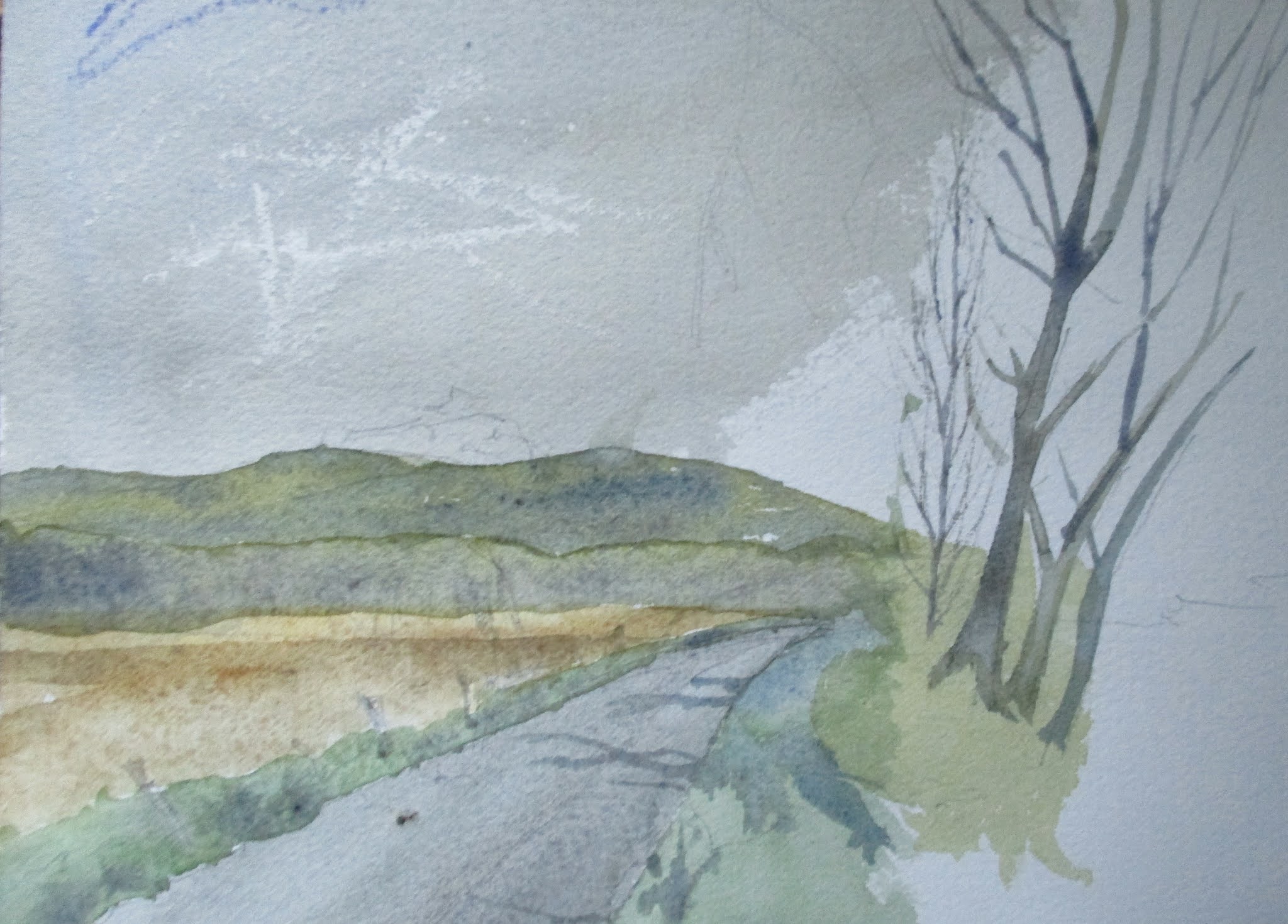
John Singer Sargent used wax resist as one of his watercolor techniques. After studying up on some of his watercolors I figured I would give it a try.

It dawned on me that I had four wax resist pencils in my studio. On my desk I have white, ultramarine, black and burnt sienna. You can see that I used the white and ultramarine in the upper left corner. I am still figuring out how to best use them but for the right application they look promising.

Wax resist can be used to preserve the white of the paper in some areas or to provide texture or to strengthen your drawing. I think they are best used as an accent in your painting but I suspect other uses will reveal themselves.


Wednesday, June 2, 2021

Richard Schmid


Richard Schmid(1934-2021) passed away just as I started to read his book, ALLA PRIMA: Everything I Know About Painting. This timing added value to my reading. In particular, I admired Schmid's work, primarily for his artistic skill but at times because he featured local subject matter.

In fact earlier today, in the local used bookstore, this very same book I saw displayed on sale by the checkout counter. His books always seem to be in great demand and thus hard to find and pricey.

Schmid, certainly well known for his oil paintings, did paint in watercolor and gouache. However, of the few watercolors from him, that I have seen, look like his oils with vibrant colors and such a painterly touch. I suspect he used a palette knife in his watercolors as well.

Several years ago I took an oil painting workshop in Putney, Vermont where a group called the Putney Painters would gather, along with other fine artists from across the country and globe. It was not a workshop that he offered but his presence dominated the experience with samples of his drawings and oil studies on hand and discussions of his techniques.